

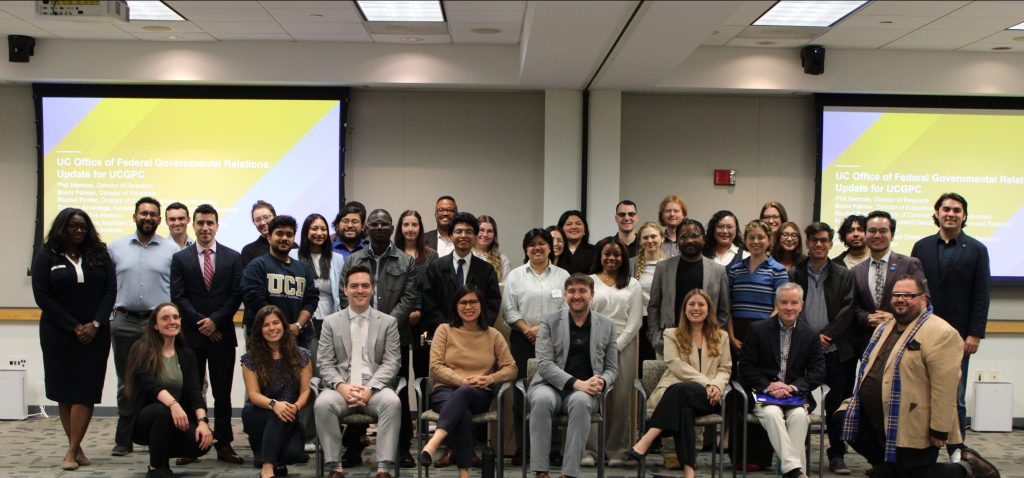
Before jumping into this essay, I would like to preface it with context. Since June 2025, I have been serving as the President of the UC Graduate & Professional Council, representing the 63,000+ students from across the State, encompassing 10 campuses, 6 health care centers, and 3 national laboratories. Through my role, I work closely with the UC Regents, President Milliken, the various offices of the UC Office of the President, and the University of California Student Association (representing the 200,000+ undergraduate students of the UC). Additionally, my analysis is based on the wisdom, experience, and knowledge that my board has been generous to share through our time together.
Now, I find myself at a crossroads, in a liminal space where I must make a decision- do I continue in student advocacy, or move on to focus on other things? I applied to be Student Regent, however my application was rejected for interview, as were all applications from members of the UC Graduate & Professional Council and our sibling organization, the UC Student Association. This has made me question my leadership, my methods as an advocate, and ultimately whether my voice is even welcome in this space.
With that, I share with you my analysis, which served as my application essay for the position.
In the summer of 2025, the Trump administration launched an unprecedented attack on higher education in the United States. UCLA was the first public university to face these actions directly, but consequently the effects have spread across the University of California system. Nearly 300,000 students and more than 200,000 faculty and staff are affected by the federal cuts and policy shifts. Since the University operates within a political and financial framework shaped by the federal government, these external pressures have fundamentally influenced the institution’s decision-making process. As a result, it is difficult to address any internal challenges without first confronting the external political forces that are violently shaping our institution.
These cuts pose a serious threat to our future because federal research funding is one of the system’s most important sources of support. Each year, UC campuses receive billions of dollars from agencies such as the National Institutes of Health, the National Science Foundation, the United States Department of Energy, and the National Aeronautics and Space Administration. These grants fund research labs, equipment, graduate student stipends, postdoctoral researchers, and the scientific projects that drive innovation across the country. If the funding stream from the federal government does not stabilize or is canceled, the effects will reach far beyond research output. The university will likely face fewer student opportunities, larger class sizes, significant civil unrest, and long-term damage to the University’s global reputation. Without this funding source, we would have decreased admissions, created a reduction of Academic Student Employee positions, and triggered the potential closure of labs. Over time, this would mean fewer scientists, doctors, engineers, academic scholars, and other professionals entering California’s workforce.
While the attacks are focused on research and graduate education, undergraduate students would also experience the effects through the loss of teaching assistants, fewer course offerings, and reduced (if not eliminated) opportunities to work in labs. The consequences would extend beyond our campuses as the system supports thousands of staff members, contractors, local partners, and their local economies. A decline in federal funding, therefore, leads to a corollary reduction in jobs, investments, and economic activities across the state of California. If the university were to lose any significant portion of federal funding, it would not be able to sustain the institution it has long been.
The loss of funding and the accompanying political pressures represent the most significant challenges facing the University of California today. However, this is about more than finances. The political marionetting affects daily life on campus, shaping access to student services, the protection of civil rights, and the opportunities available to students. Even so, the UC can respond to these pressures while staying true to its mission of education, research, and public service, adapting when necessary to continue serving students and the people of California. Difficult moments can strengthen institutions, much like iron is forged in fire. By fortifying its community of students, alumni, faculty, and staff, diversifying funding sources, and protecting access to education for Californians, we can preserve and build upon the abundant opportunities the University provides for generations to come.
The University of California has an extended community of three million people; by focusing on community-building, it can strengthen its collective advocacy at the federal level. In recent years, the trust between students and administration has been strained, though it is not beyond repair. Rebuilding this trust can begin with clear oversight metrics, transparent accountability, and the consistent inclusion of students in systemwide committees. While the Office of the President has made efforts in all three areas, progress has been uneven over recent years, leaving students excluded from crucial conversations.
Once this foundation of trust is restored, the University can leverage its powerful voice and its deep connections to alumni across the country. These voices can use the art of storytelling to bridge the partisan divide and strengthen the institution from the inside out. Research from the University of Oxford and Ohio State University demonstrates the power of storytelling. According to lead researchers Dr. Emily Kubin and Dr. Kurt Gray, “[S]torytelling reduces polarisation and measurably strengthens emotional connection, active citizenship and social cohesion.”[1] Using storytelling in advocacy can break down us-versus-them barriers, but that effort must begin at home. Administration, staff, faculty, and students must first come together to rebuild trust and a shared sense of purpose.
The UC already plays a strong role in conversations on research investment and higher education policy, but expanding advocacy to include the broader community, not just a select few, will exponentially amplify its impact. This could take the form of a coordinated effort of university leadership, faculty organizations, and robust student coalitions, building on the work led by the UC Advocacy Network and the systemwide Federal Government Relations team. By highlighting how UC research drives public health, economic growth, and national competitiveness, the University can cultivate bipartisan support for stable research funding, that in turn will strengthen the future of the University and the country.
It is a crucial time for the UC to augment and diversify its funding sources. Building on the ongoing state-level efforts, such as SB 895, the UC should continue this expansion and seek to decentralize reliance on federal funding mitigating risk and reducing our vulnerabilities during the current political climate. The UC can learn from other resilient communities and organizations that reflect our own demographics. This can include strengthening partnerships with private foundations, philanthropists, public-private partnerships, and industry collaborators. Done thoughtfully and with care, these efforts can give the University greater freedom to follow scientific priorities rather than political whims. Establishing a strong contingency fund, improving financial forecasting, and investing in more efficient grant management will also allow the system to adjust more effectively to sudden policy shifts and federal instabilities. Additionally, developing intercampus programs, clearly dictated through written policy, can allow campuses to share resources, coordinate responses, and enhance institutional stability while still respecting shared governance and each campus’s autonomy.
Above all, this is the time for the University of California to emphasize its public mission and societal impact. We must demonstrate how UC research benefits communities, acknowledging to students and faculty the importance and value of their work and show policymakers why our contributions matter. While political shifts will continue, and extremes will eventually subside, the University must consistently highlight the tangible benefits of UC research and education. These efforts reinforce the mission of the UC, what we stand for, and what we can continue to achieve despite external threats.
[1] Kubin, Emily and Kurt Gray. “New Study Finds Storytelling Reduces Political Polarisation” in Experimental Psychology. https://www.psy.ox.ac.uk/news/new-study-finds-storytelling-reduces-political-polarisation#:~:text=Study%20of%20380%20high%20school,share%20it%20with%20a%20partner. For more information on the study see Kubin, Emily et al. Promoting Empathy, Connection, And Pro-Sociality Through Storytelling In American High Schools: A Collaboration Between Academics and Practitioners. PsyArXiv, January 19, 2026.
Want to read more?
You Belong in These Spaces
This speech was given April 21, 2026 at the annual Hispanic Association of Colleges and Universities (HACU) in Washington D.C. Piyalli and Good morning everyone, I am deeply honored to be here today with all of you to share space, shape policy, and work for the betterment of this country, not only for ourselves but…

NAGPRA, AI, and Our Responsibility: UCGPC President’s Address to the Regents
Mission Bay Conference Center University of California, San Francisco 9:30 AM on March 18, 2026 Piyalli and good morning Regents, We meet again- for the fifth time out of six. Each time I have come before this board, I have made a conscious effort to remind everyone, myself included, that this land is not…
State of the Council Address
Presented at the UC Grad Summit, hosted by UCGPC “I would like to start by taking the time to acknowledge the access, privilege, and opportunity that we all have as a direct result of the dispossession of the communities that lived in concert with, and as stewards of the land long before the University of…
 Stephanie Valadez, M.M.
Leave a comment