

This speech was given April 21, 2026 at the annual Hispanic Association of Colleges and Universities (HACU) in Washington D.C.
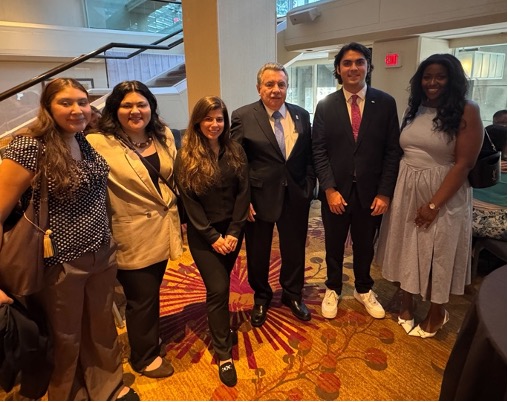
Piyalli and Good morning everyone,
I am deeply honored to be here today with all of you to share space, shape policy, and work for the betterment of this country, not only for ourselves but for our posterity. I would like to start by taking the time to acknowledge the access, privilege, and opportunity that we all have as a direct result of the dispossession of the communities that lived in concert with, and as stewards of the land. As direct beneficiaries of the heinous acts leading up to and through the formation of land grant universities, I acknowledge that I am, and everyone else on the UCLA campus are occupying the ancestral lands of the Gabrielino Tongva people, who lived on and cultivated the land for thousands of years before settlers arrived, subsequently stealing their land, enslaving their people and forcing them into labor. Washington, D.C. is located on the ancestral lands of the Nacotchtank, Piscataway, and Pamunkey peoples, who served as stewards of the region for generations.
My name is Stephanie Valadez and I am the President of the University of California Graduate and Professional Council. Currently, I am a PhD student in Ethnomusicology and a Cota-Robles Fellow in the Herb Alpert School of Music at UCLA. I have spent the last three years at UC Santa Cruz studying Cross-Cultural Musicology with a Designated Emphasis in Critical Race and Ethnic Studies. UCGPC is a 501c3 non-profit organization that represents over 63,000 graduate and professional students across the ten campuses of the University of California including 5 HSIs campuses, UC Irvine, UC Merced, UC Riverside, UC Santa Barbara, and UC Sant a Cruz, as well as 2 emerging HSIs, UC Davis and UC Los Angeles. UCGPC uplifts student voices through education, advocacy, and community-building so that every UC graduate and professional student can thrive academically and personally. At UCGPC, we strive for an equitable UC system where basic needs are met, mental health is prioritized, and research, teaching, and public service flourish. In our work, we aim to be equitable, transparent, collaborative, sustainable, and inclusive. It is of the utmost importance that all our advocacy is evidence-based and that we take every step with integrity and respect.
From the time I was born, I was taught to shapeshift in ways I didn’t yet have the wherewithal to fully understand or articulate. I grew up between the San Francisco Bay Area and Mexico City. When in the United States, I learned to softening my Spanish, anglicize my name, stay quiet about the parts of me that would “expose” who I am. These were survival tactics passed down from my mother. I absorbed self-hate and a quiet understanding that belonging meant fitting in, and fitting in meant being White. Without the space to affirm my identity, the hiding became a core part of being. I was in a constant negotiation of who I was in different spaces. In Mexico, soy Mexicana… In the United States, I am “American” a term that, in itself, erases all of the beautiful diversity of cultures and communities across turtle island and Anahuac. My mother’s survival tactics were a toxicity running through my veins that I didn’t even know was poisoning me.
As a young student, I attended a private school, a CSU, and community college – eventually resulting in my Bachelor’s of Arts, subsequently I studied at a Conservatory receiving two professional master’s degrees. My identity was shifting, but still in all these spaces there was no space for me to be Latina. After three degrees, I had to pick up and leave the United States. My husband was deported, and so a new adventure began. I followed him and we built a beautiful life with our two children. It took the US government officially telling me that my family DOES NOT belong in this country, for me to wake up and acknowledge that I was part of the problem by accepting, conforming, and acculturating.
The next five years drastically changed me, who I am, and how I present in this world. After five years, when my husband’s ban was supposed to be up, we started the process again to apply for his residency while I started the process of applying to PhD programs. This time around, when I stepped back into academia, I was someone new… someone new, yet also someone who was there the whole time. I came back unapologetic, present, and honest about who I am. Three years ago, I started my PhD at the University of California, Santa Cruz, a Hispanic-Serving Institution just a couple hours south of San Francisco. At Santa Cruz, I joined the Mariachi Ensemble and found my community. I engaged with other Latinx scholars and was introduced to the vast network of faculty and students with a shared identity that honored our diversity, epistemologies, and perspectives. In Santa Cruz, I learned to respect who I am and stop apologizing just for existing. This is also where I became involved in student advocacy, because I am not the only one who has felt invisible. I now had the power to stand up and advocate on behalf of those who do not have the privilege of being in these spaces. HSI and other MSI institutions create space for community, belonging, and inclusion, yet are now under federal threat. Beyond the funding, HSI produces an environment for funding at other levels creating a cohesive network of support, where students can thrive and authentically be present.
Every day I spend time doing advocacy, be it in my state or here in Washington, I remind myself of who I represent, and by being her you all are also holding space for your communities in bringing their stories to the table to affect change and legislation. Now that I am a mother, in the age of ICE, I find myself whispering to my children the same survival tactics I worked to undo. When we get stopped by border patrol, or questioned, I remind them to silence their native tongue. Not to lose their pride in who they are or where they are from, but to protect themselves in the moment. The irony of these actions is not lost on me- but I chose to approach it as an opportunity to teach them more about who they are, to appreciate their diversity, and find their community. While we silence who we are to avoid violence in the moment, I then chose to show up in these spaces to change the world my children will soon be taking over, because policy is written about us every day without consulting us. I tell you all of this to highlight the importance of being unapologetically present in your advocacy. Sometimes we must adapt for survival, but you must remember that you belong in these spaces, and the stories of your community belong in these spaces too.
Want to read more?
Like Iron is Forged in Fire: A Situational Analysis of the University of California
Before jumping into this essay, I would like to preface it with context. Since June 2025, I have been serving as the President of the UC Graduate & Professional Council, representing the 63,000+ students from across the State, encompassing 10 campuses, 6 health care centers, and 3 national laboratories. Through my role, I work closely…

NAGPRA, AI, and Our Responsibility: UCGPC President’s Address to the Regents
Mission Bay Conference Center University of California, San Francisco 9:30 AM on March 18, 2026 Piyalli and good morning Regents, We meet again- for the fifth time out of six. Each time I have come before this board, I have made a conscious effort to remind everyone, myself included, that this land is not…
State of the Council Address
Presented at the UC Grad Summit, hosted by UCGPC “I would like to start by taking the time to acknowledge the access, privilege, and opportunity that we all have as a direct result of the dispossession of the communities that lived in concert with, and as stewards of the land long before the University of…
 Stephanie Valadez, M.M.
Leave a comment